Author: Pastor Brian

  • Pastor vs. Preacher

    Is it just semantics or is there a difference between the two titles?

    Defining pastor and preacher. Throw in minister for contrast.

    Pastor: The spiritual leader of a Christian congregation. The word comes from the Latin noun for “shepherd”. Their primary duties include leading worship, preaching, teaching the Bible, providing spiritual counseling, and caring for the members of their church (according to wikipedia).

    Preacher: A person who delivers religious sermons or proclaims the gospel to an assembly of people. While highly associated with Christian ministry, the term can also refer to public speakers who earnestly advocate for a specific moral, social, or philosophical worldview (according to Merriam-Webster).

    Minister: an ordained religious leader or a high-ranking government official in charge of a department. The word comes from the Latin word for “servant,” which reflects its core meaning of providing service to a community or cause (according to vocabulary.com).

    Biblically defining pastor, elder, bishop/overseer, and preacher.

    Pastor: (Fundamentally defined as a shepherd who leads, feeds, and protects God’s people. The roles of pastor (poimēn pronounced poy-mane’), elder (presbuteros), and bishop (episkopos)/overseer (episkope) are used interchangeably within the context of the KJV Bible translation, though each of these greek words have unique definitions.)

    Hebrew Transliteration: rāʿâ (H7462)

    רָעָה râʻâh, raw-aw’; a primitive root; to tend a flock; i.e. pasture it; intransitively, to graze (literally or figuratively); generally to rule; by extension, to associate with (as a friend):—× break, companion, keep company with, devour, eat up, evil entreat, feed, use as a friend, make friendship with, herdman, keep (sheep) (-er), pastor, shearing house, shepherd, wander, waste.

    Greek Transliteration: poimēn (G4166)

    ποιμήν poimḗn, poy-mane’; of uncertain affinity; a shepherd (literally or figuratively):—shepherd, pastor.

    Elder: (An individual possessing spiritual maturity, wisdom, and recognized leadership.)

    Hebrew Transliteration: gāḏôl (H1418)

    גָּדוֹל gâdôwl, gaw-dole’; or גָּדֹל gâdôl; (shortened) from H1431; great (in any sense); hence, older; also insolent:— aloud, elder(-est), exceeding(-ly), far, (man of) great (man, matter, thing,-er,-ness), high, long, loud, mighty, more, much, noble, proud thing, × sore, (×) very.

    Greek Transliteration: presbyteros (G4245)

    πρεσβύτεροςpresbýteros, pres-boo’-ter-os; comparative of πρέσβυς présbys (elderly); older; as noun, a senior; specially, an Israelite Sanhedrist (also figuratively, member of the celestial council) or Christian “presbyter”:—elder(-est), old.

    Bishop/Overseer: (A bishop (translated from the Greek word episkopos) and an overseer (or episkope) refer to the exact same church leadership role. These terms describe a spiritual superintendent, shepherd, or guardian responsible for guiding, protecting, and feeding the local congregation.)

    Hebrew Transliteration: šāṭar (H7860) “overseer”

    שֹׁטֵר shôṭêr, sho-tare’; active participle of an otherwise unused root probably meaning to write; properly, a scribe, i.e. (by analogy or implication) an official superintendent or magistrate:—officer, overseer, ruler.

    Greek Transliteration: episkopos (G1985) “bishop”

    ἐπίσκοπος epískopos,ep-is’-kop-os; from G1909 and G4649 (in the sense of G1983); a superintendent, i.e. Christian officer in genitive case charge of a (or the) church (literally or figuratively):—bishop, overseer.

    Preacher: (A public herald, messenger, or proclaimer of divine truth. The role centers on delivering God’s Word to the people, often with an emphasis on repentance, faith, and the teachings of the gospel.)

    Hebrew Transliteration: qōheleṯ (H6953)

    קֹהֶלֶת qôheleth, ko-heh’-leth; feminine of active participle from H6950; a (female) assembler (i.e. lecturer); abstractly, preaching (used as a ‘nom de plume’, Koheleth):—preacher.

    Greek Transliteration: kēryssō (G2784)

    κηρύσσω kērýssō,kay-roos’-so; of uncertain affinity; to herald (as a public crier), especially divine truth (the gospel):—preacher(-er), proclaim, publish.

    It is important to convey and grasp the idea of interchangeability between the three titles “pastor”, “elder”, and “bishop”. This is common understanding amongst Christian theologians and can be further studied and revealed by the Holy Spirit in the word of God when reading Acts, Ephesians, 1 Timothy, Titus, Hebrews, and 1 Peter. One can determine through diligent study of the Word that the title of shepherd or pastor assumes the roles and expectations of the elder and bishop/overseer. Each of their responsibilities and expectations clearly overlap and are used interchangeably by Paul and Peter. For this reason, it is important to qualify a man to any of these titles based on how scripture defines such qualifications and to ensure that the man of God adheres strictly to said qualifications while being held appropriately accountable for his actions and duties.

    Ephesians 4:11 – Offices – or gifts according to verse 8 – were given, and pastor is a title of that office or gift. Preacher is a broad title that can be assumed by the individual that preaches – or speaks – the word of God, as we all are commanded to do in the Great Commissions of the Synoptic Gospels (Matthew 28:19-20, Mark 16:15-18, and Luke 24:46-48). Further to that point, the title of the book of Ecclesiastes means Preacher, which was written by king Solomon. Understanding Old Testament law, we would know that a priest (from the tribe of Levi) and a king (from the tribe of Judah) cannot be from the same lineage. So king Solomon, who was of the tribe of Judah, was not claiming to be a priest, or pastor/shepherd, when pontificating the book of Ecclesiastes. According to 1 Timothy 2:5 and Hebrews 2:17; 4:14-16, we now have one Priest, one Mediator, that we go through, that is the LORD Jesus Christ. According to the Bible, a priest is a divinely appointed mediator between God and humanity. Their primary duties were to offer gifts and sacrifices for sins and to intercede for the people – which is exactly what Jesus Christ did for us on the cross and continues to do for us now by interceding between us and the Father.

    About the “So What” part: Why is it important to understand these differences and similarities between these titles? Firstly, we are commanded to study and show ourselves approved unto God, a workman that needeth not to be ashamed, rightly dividing the word of truth, because after all, all scripture is given by inspiration of God, and is profitable for doctrine, for reproof, for correction, for instruction in righteousness: That the man of God may be perfect, thoroughly furnished unto all good works. Now how could we fulfill the commands and promises of 2 Timothy 2:15 and 3:16-17 if we aren’t acknowledging that there are vast differences between words and that they matter? To be a preacher is not to necessarily hold the weight and burden of the office unto which God calls a man to shepherd. But in order to pastor and shepherd a flock of our Lord Jesus Christ, knowing how to preach is a part of the full manifold of responsibilities such a man must possess, for he will be examined by the Lord in such a heavy undertaking (James 3:1). Secondly, because as we further examine Paul’s words to Timothy, we see that as a pastor, preaching comes also with responsibilities given to a shepherd and not just an orator: 2 Timothy 4:2 exhorts to not just preach the word, being ready in season and out of season, but to do so with reproof, rebuking, exhortation, with great patience and teaching – tasks charged by commandment of God to the office of Pastor, Elder, and Bishop/Overseer throughout New Testament scripture.
  • Why is God a jealous God? 

    Exodus 34:14 “For thou shalt worship no other god: for the LORD, whose name is Jealous, is a jealous God:”

    In 1 Kings 8:27, Solomon is in the middle of dedicating the newly created temple unto the Lord and acknowledges that the infinite God could not be contained in the heavens, even the heaven of heavens, and thus questioned how God could dwell on earth in a temple that was built by him, a man. One millennia later, Paul rhetorically asks the Corinthians,

    “What? know ye not that your body is the temple of the Holy Ghost which is in you, which ye have of God, and ye are not your own?” (1 Corinthians 6:19).

    Juxtaposing these two realities of temples – one built from stone, wood and other earthen materials, and a bodily temple from the God-breathed clay created in His image – we can easily conclude that anything taking space in these temples, no matter the size or significance, takes space that the LORD our God wants to utilize to give us fullness in Him. This is why God wants us to rid ourselves of idols; not a single thing should come before God in our lives as He commands in Leviticus 19:4 (idol(s) Strong’s H457: el-eel’ “of nought, good for nothing, worthless: of false gods”). God isn’t jealous out of insecurity, He’s jealous of the finite and limited space of your temple that rightfully belongs to Him as your Creator. He wants the fullness of Himself within you, and every nanoparticle and millisecond of space and time consumed by anything other than His will for you is keeping Him from giving you all He has for you and your life. 

    The question the individual believer must reconcile within themselves is simple, yet deathly difficult. It requires an honesty with one’s self that is rarely achieved (if ever) outside of the power given by the intimate indwelling of the Holy Spirit. It is an exercise one must consistently contemplate with a repentant heart toward the Father as often as one communes with Him. Prayerfully meditate on your life, and take inventory of everything: From relationships to possessions, from knowledge to riches, even the very breath in your lungs that drives the speech from your tongue – anything and everything – and determine in your heart by the revelation of the Holy Spirit what you are holding onto that is possessing space within your temple where the Lord ought to possess. If one is “white-knuckling” their wealth, their health, their relationships or things else at all, unwilling to place it on the alter of sacrifice (Romans 12:1-2), they are in danger of making such a thing an idol before (or in front of) God. The tricky part in identifying these things is that it could be either the haves or the have nots. Whether you have health or have not health, if it becomes your identity, it becomes an idol. Whether you have wealth or have not wealth, if it becomes your identity, it becomes an idol. Idolatry can come also in the form of self flagellation. The Lord doesn’t want you to beat yourself up for falling short, He wants your attention in the form of praise for what He has done through the work of Jesus Christ on the cross. The key is to identify in what, or in whom, you place your identity. Considers Jesus’ words in the context of Matthew 8:21-22,

    “And another of his disciples said unto him, Lord, suffer me first to go and bury my father. But Jesus said unto him, Follow me; and let the dead bury their dead.”

    This disciple’s father has not yet died, but was concerned with receiving his inheritance from his father before departing to follow Jesus. The attention of his heart was divided and Jesus was having no part of that. He is jealous for all of you, and He wants all of you now. 

    We can avoid kindling the jealousy of our Creator by defeating the sin of idolatry in our lives, and identifying the idolatry is the key to its defeat. But make no mistake, this isn’t one simple sin that is defeated wherein you then move on to other things. This can be a seemingly perpetual onslaught of identifying and defeating idolatrous sins where the battle has an ebb and flow. The enemy takes his strategy of this battle seriously because he knows that if he can keep you in bondage to idols, you will be that much further from God which keeps you ineffective for God’s kingdom and His will. So, take some time to search out your heart’s condition, begin to identify things you are struggling to release, and read on to learn how to defeat that struggle. 

    [selah]

    Defeating sin: Offering the sacrifice of praise

    Do not beat yourself up for sinning, rather declare the truth that you are the Righteousness of God through Jesus Christ: 2 Corinthians 5:21 reads,

    “For he hath made him to be sin for us, who knew no sin; that we might be made the righteousness of God in him.”

    The Father made Jesus who was and is innocent to be sin in our place in order that we might be seen as the righteousness of God because of what Jesus accomplished. John writes in Revelation 12:10,

    “And I heard a loud voice saying in heaven, Now is come salvation, and strength, and the kingdom of our God, and the power of his Christ: for the accuser of our brethren is cast down, which accused them before our God day and night.”

    We already have an accuser, the devil. Why help him out when we’ve been forgiven and Jesus advocates on our behalf as our Defense Attorney in God’s court?

    “My little children, these things write I unto you, that ye sin not. And if any man sin, we have an advocate with the Father, Jesus Christ the righteous:” 1 John 2:1.

    God created a situation for us where we are free from all charges, cleansed as innocent because Jesus took the penalty and paid it in full. This is our reality! This is amazing! This is praiseworthy! And praiseworthy indeed, as this drives our attitude going forward: to give continual praise and glory to God because, in spite of a sinful condition, He chose to pave the path to salvation through Jesus Christ. Our attitudes going forward should not be continual sorrow for missing the mark. We have been given the opportunity to shift our attitude from sorrow to awe and thanksgiving. In Hebrews 13:15, the “sacrifice of praise” is defined as continually offering the “fruit of our lips” to God – giving thanks to Him through Jesus. It represents a spiritual sacrifice of worship that replaces Old Testament animal sacrifices, requiring believers to praise God regardless of circumstances, often in the midst of hardship. It is the “fruit of our lips,” meaning vocal praise, songs, and thanksgiving. Hebrews 13:15 says,

    “By him therefore let us offer the sacrifice of praise to God continually, that is, the fruit of our lips giving thanks to his name.”

    The “sacrifice of praise” aspect is described as sacrificial because it is offered even when a person is hurting, facing trials, or when praise feels difficult. It involves a “dying to one’s self” and choosing to trust God’s goodness. We do this “continually”: This praise is not meant to be situational, but a persistent offering, regardless of life’s challenges. 

    According to Psalm 50:23, “Whoso offereth praise glorifieth me.” Related to such praise is a natural course of action born out of gratitude: Hebrews 13:16 instructs that this praise is paired with doing good and sharing, as “with such sacrifices God is well pleased.” It is a voluntary, heartfelt offering of thanksgiving that acknowledges God’s character despite external circumstances – it is unconditionally given, not a payment rendered for forgiveness.

    Psalm 51:17 – What about the sacrifices of God being “a broken spirit: a broken and contrite heart”?

    While praise for one’s forgiveness glories God, godly sorrow works repentance unto salvation. Notice the direction of each of these elements: Praise goes unto God, sorrow works repentance in the man. It’s not that Godly sorrow should go unto God, but praise should be offered in gratitude for what was done for the believer. Likewise, one should never praise themselves for what God has wrought in them, but sorrow for their missing the mark. Sorrow comes naturally when the onset of understanding comes that their actions are what created the circumstance for Jesus to go to the cross. God does seek that we turn to Him with all of our heart, and with fasting, and with weeping, and with mourning (Joel 2:12-14), but this is done as a reaction to the revelation of what one was doing out of their ignorance to God’s way. As God knows our own hearts better than we do (Jeremiah 17:10, 1 Chronicles 28:9, Psalm 139:1-2), we can be certain that He knows of our godly sorrow and thus is pleased and glorified when after we turn back to Him, such sorrow is turned into praise unto Him.

    A penitent man is one who exhibits godly sorrow for sin, leading to a change of heart, mind, and action, resulting in forgiveness and salvation. Key scriptures indicate that true repentance is not about sorrow, but a turning from sin towards God and that such sorrow flows naturally from a contrite heart. While we know that God sees this in us, it is not necessarily for His benefit in as much as it is for us and our growth. He is indeed blessed by our repentance and obedience (Ezekiel 33:11) and that is a gain for Him, however, we read in Ezekiel 18:21-23 how if the wicked would turn from all their sins that they committed, keep God’s statutes, do what is lawful and right, they will live and not die. Paul expounds on this idea in 2 Corinthians 7:10-11 when he shows where the Corinthians had godly sorrow it wrought carefulness, clearing themselves, creating a righteous indignation toward their wrongfulness, turning them to fear (reverence) the Lord, bearing a vehement desire and zeal to revenge all disobedience (2 Corinthians 10:6) with glorifying the Lord. In this, they proved themselves redeemed from their sin. So does repentance come before salvation? 

    Or is it that repentance is an evidence that salvation has been obtained? Salvation without repentance is a false conversion. But repentance cannot be done without first having the willingness to submit one’s self to the Lord for salvation, and thus repentance becomes a true mark of the saved believer. Consider in Acts 3:19 when Peter said,

    “Repent ye therefore, and be converted, that your sins may be blotted out, when the times of refreshing shall come from the presence of the Lord;”

    The Lord, through the faith of Peter and John, heals this lame man who sat daily outside the temple at the gate called Beautiful, a man whom those who were present knew to be legitimately lame from birth as they too saw him daily. With this miracle that they saw with their own eyes, they in turn believed – but on what did they believe? Peter discerns that they are “greatly wondering” (v. 11) and compels those inside the temple to receive the gospel message (vv. 12-26), and most importantly to repent of their unbelief and iniquities and receive salvation (v. 19). 

    A penitent person is sorrowful for past conduct and shows a “change of mind” that includes a resolve to no longer sin. Jesus emphasized, “I tell you, Nay: but, except ye repent, ye shall all likewise perish” (Luke 13:3, 5). The result of repentance brings joy in heaven (Luke 15:7) and results in the blotting out of sins (Acts 3:19). A penitent person turns to the Lord with all heart, fasting, weeping, and mourning (Joel 2:12-14), acknowledging sins and turning from wickedness and is humble before God (2 Kings 22:19). The broken and contrite heart is the sacrifice the Lord seeks (Psalm 51:17). 

  • The fear of the LORD is…

    The fear of the LORD is…

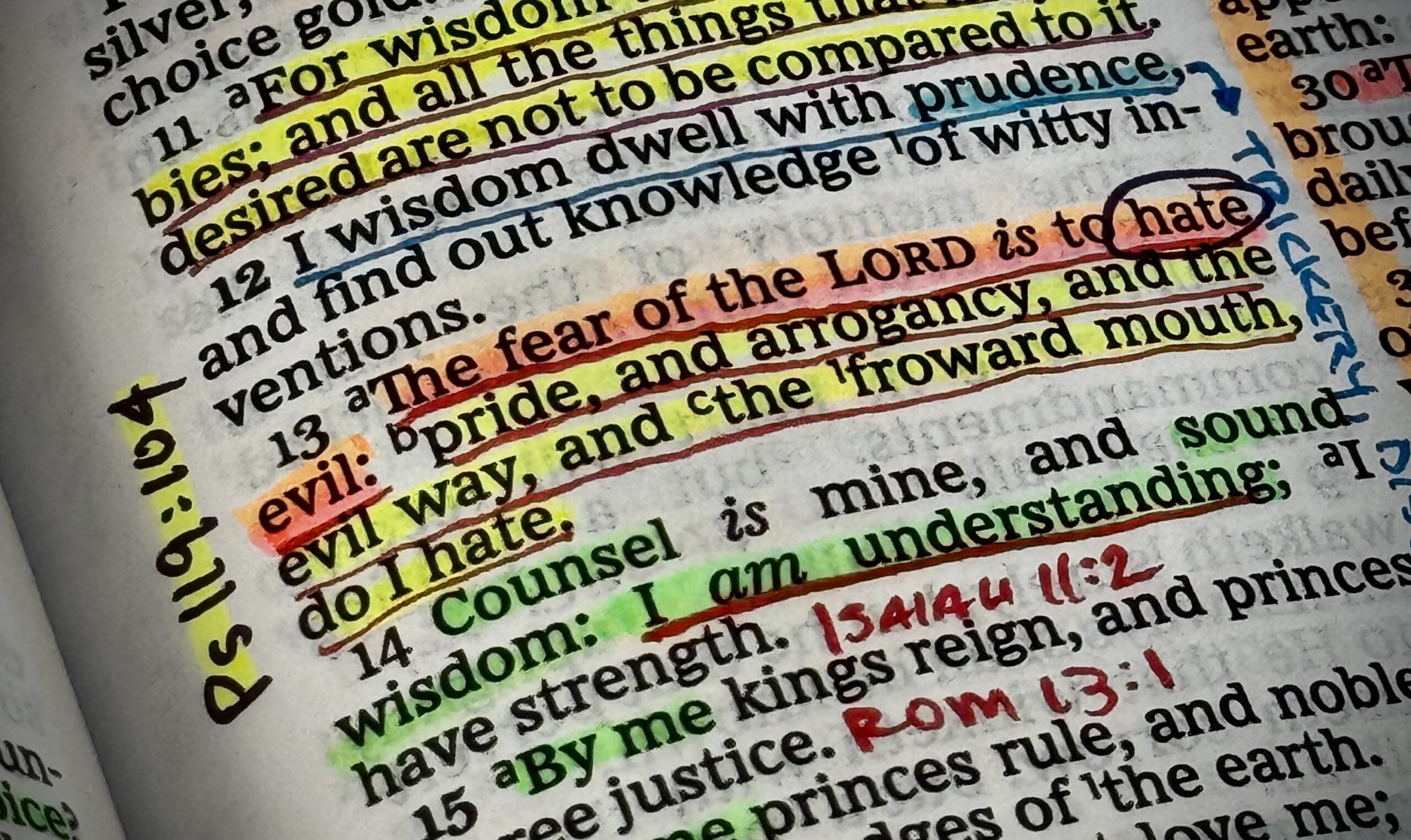
    “The fear of the LORD is to hate evil: pride, and arrogance, and the evil way, and the froward mouth, do I hate.” Proverbs 8:13

    The phrase, “fear the LORD” appears 30 times in the Bible, mostly as commands, some in the context of a question (such as in Jeremiah 26:19). We often ask ourselves what it means to fear the LORD. How do we fear the LORD if it seems at first glance contradictory to have fear; 2 Timothy 1:7 says that God has not given us the spirit of fear, but a spirit of power, love and a sound mind. How can we fear the LORD if we aren’t given a spirit of fear? The fact is that fear is a part of life, and what we fear is what matters. The context of 2 Timothy 1:7 is not to be fearless, but it is in regard to not fearing the world and their response to the testimony of our LORD. Paul exhorts young Timothy to not be ashamed of that testimony and to be a partaker of the afflictions of the gospel according to the power of God. In Matthew 10:28, Jesus also tells us not to fear those which kill the body and not the soul, “but rather fear him which is able to destroy both soul and body in hell.” Understanding the emotion of fear and how to navigate it is what the Bible tells us to do – not to avoid fear altogether. 

    It is said that the Bible tells us 365 times to “fear not”, or “be not afraid”, or some other variation of that sort – one for every day of the year! While that claim may be challenged by skeptics, being used to defraud Christians looking to spread some encouragement, it still stands that scripture teaches us what to fear and what not to fear. Proverbs 8:13 clearly tells us what it means to fear the LORD: Hate evil, hate pride, hate arrogance, hate the evil way, hate the froward mouth. The Bible tells us more of what the LORD hates, giving us further clarification as to how we can fear Him: Proverbs 6:16-19 explains the following: “These six things doth the LORD hate: yea, seven are an abomination unto him: 17 A proud look, a lying tongue, and hands that shed innocent blood, 18 An heart that deviseth wicked imaginations, feet that be swift in running to mischief, 19 A false witness that speaketh lies, and he that soweth discord among brethren.” 

    Psalm 119:97-104 is perhaps one of my most treasured understandings about how to rightly fear the LORD. The author, widely attributed to King David but without certain evidence thereof, writes 22 stanzas – one for each of the 22 Hebrew letters of their alphabet, and it is in the letter of MEM that it is written about how keeping God’s law and leaning in toward Him is what leads to the same conclusion that Proverbs 8:13 delivers: Seven verses leading to the 8th – to hate every false way.

    97 O how love I thy law! it is my meditation all the day. 

    98 Thou through thy commandments hast made me wiser than mine enemies: for they are ever with me. 

    99 I have more understanding than all my teachers: for thy testimonies are my meditation. 

    100 I understand more than the ancients, because I keep thy precepts. 

    101 I have refrained my feet from every evil way, that I might keep thy word. 

    102 I have not departed from thy judgments: for thou hast taught me. 

    103 How sweet are thy words unto my taste! yea, sweeter than honey to my mouth! 

    104 Through thy precepts I get understanding: therefore I hate every false way.

    Hate is a very strong word, and my mom raised me to use that word sparingly, knowing that the Bible uses it in the harshest of realities. Her voice echoes in my memory, “be careful about what you say you hate. Hate is a very strong word.” Proverbs usage of hate in chapter 8 verse 13 is found in the Strong’s Concordance as:

    H8130: שָׂנֵא śānē’ saw-nay’; a primitive root; to hate (personally): – enemy, for, (be) hate(-ful, -r), odious, x utterly.

    To paraphrase in my own words: To personally hate, or be hateful of, or a hater of; such as toward an enemy or foe. 

    Being that we’re in a spiritual battle (Ephesians 6:12, 2 Timothy 2:3-4), on a battlefield for the souls of the lost (Mark 16:15, Proverbs 11:30), our enemy must be hated, which drives us to remain focused and uncompromised in our mission. Who is our enemy? Our enemy is the enemy of the LORD God: Evil, pride, arrogance, evil ways, froward mouths, a proud look, a lying tongue, shedding innocent blood, wicked imaginations and the hearts that devises them, mischief and the feet that run to it, false witnesses, discord, and the one that sows it among the brethren, and cowards – our enemy is comfort, convenience, and consumerism, which leads to compromise and cowardice. When we learn to hate what He hates, we will be more effective on the battlefield. How do we hate this enemy? Be uncomfortable and sacrificial (Romans 12:1, Matthew 20:16), do not be conformed to this culture, this world, but be transformed by the renewing of your mind (Romans 12:2), and having knowledge and knowing your God, being strong and doing exploits (Daniel 11:32, Hosea 4:6). We are not called to merely sit by and pray for Jesus to do all the work, acting as victims, weak, and uncertain. Jesus commanded us to GO and PREACH (Matthew 28:18-20), He said to DO things. He’s called us to be active participants and affect the battle space for His glory (Isaiah 6:8). 

  • Dads, provoke not your children to wrath

    Dads, provoke not your children to wrath

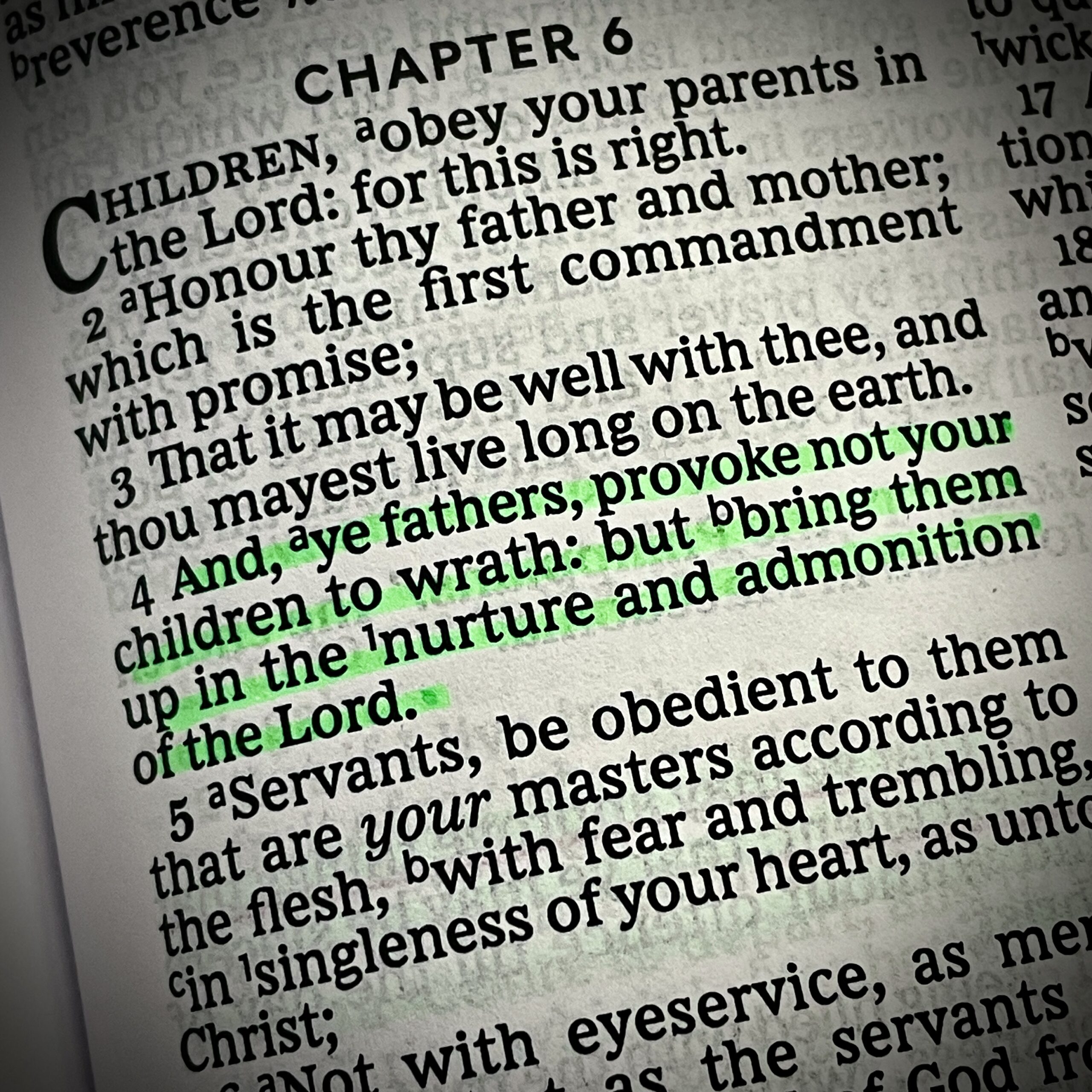
    Ephesians 6:4

    “And, ye fathers, provoke not your children to wrath: but bring them up in the nurture and admonition of the Lord.”

    This is a two-fold commandment: 1. Do not do this: “provoke not your children to wrath.” 2. Do this: “bring them up in the nurture and admonition of the Lord.”

    Provoke not your children to wrath: There are two ways to entreat with your children, Dads. Through gentleness or through harshness. The choice is ours and often times, we fall to the side of culture and not Christ and think how we need to be tough of them, when in reality, they need our love, grace and gentleness.

    Bring them up in the nurture and admonition of the Lord: Often times, we dads think that nurturing is for the mother to do. This couldn’t be further from the Truth – as you read in Ephesians 6, WE dads have a unique calling to nurture our children. We also are given the unique calling to do so with admonition.

    Remember, it was the compassionate father who ran to the prodigal son upon his return. How can we work toward being nurturing, loving, and godly fathers toward our children?

    Passages to read:

    Luke 15:11-32, The Prodigal Son.

    Psalm 127, a quiver full of arrows.

    Mark 10:13-16, Forbid not the little children.

    Matthew 18:6, The Father’s great love of children.

  • Be careful what you call heresy

    In simple terms, heresy is a belief or opinion that goes against the established and official doctrines of a particular religion. Anymore these days, it is thrown around with ease because someone likes Culver’s hamburgers over McDonald’s. It involves rejecting core tenets and is often seen as a serious error, though it can also refer to any belief that is contrary to established theory. The term originally meant “choice” or “sect” but came to be used by the church to mean a division or departure from its official beliefs. 

    It easy to see how this evolved from just an acknowledgement of differences in choice into a departure from the faith when we consider Paul’s orders in Galatians:

    Galatians 1:6-10 I marvel that ye are so soon removed from him that called you into the grace of Christ unto another gospel: 7 Which is not another; but there be some that trouble you, and would pervert the gospel of Christ. 8 But though we, or an angel from heaven, preach any other gospel unto you than that which we have preached unto you, let him be accursed. 9 As we said before, so say I now again, If any [man] preach any other gospel unto you than that ye have received, let him be accursed. 10 For do I now persuade men, or God? or do I seek to please men? for if I yet pleased men, I should not be the servant of Christ.

    With using words such as “pervert” (G3344: to transmute or corrupt) and “accursed” (G331: anathema, meaning without hope of being redeemed, excommunicated), how could one think it be so light a thing to simply have differing opinions on what the scriptures say? As if it weren’t already serious enough for him to say once in verse 8 to let them be accursed, but he doubles down in verse 9, emphasizing the seriousness with repetition. 

    Certain theologians and scholars have gone on the record saying that the only heresy that truly exists is that of preterism, whether it be partial preterism or full (also known as hyper) preterism. Without getting to deep off topic, preterism is simple an eschatological view of when prophecies were supposedly fulfilled. However, given the scope of definition of the word heresy, I would peradventure say that the only true doctrine that could be construed as heretical would be a departing from the truth of the salvific doctrines. As Paul so pointedly stated, “But though we, or an angel from heaven, preach ANY OTHER GOSPEL unto you than that which we have preached unto you, let him be accursed.”

    So, what is a salvific doctrine? Salvific is defined as leading to salvation: “the salvific power of the Lord”. This is the very message of the gospel of which Paul speaks of in the above passage from Galatians. Paul delivers this gospel message perhaps most prominently in the first letter to the Corinthians and to the Romans when he says the following: 

    1 Corinthians 15:1-4 Moreover, brethren, I declare unto you the gospel which I preached unto you, which also ye have received, and wherein ye stand; 2 By which also ye are saved, if ye keep in memory what I preached unto you, unless ye have believed in vain. 3 For I delivered unto you first of all that which I also received, how that Christ died for our sins according to the scriptures; 4 And that he was buried, and that he rose again the third day according to the scriptures:

    And in Romans, by which some call it the “Golden Road to Rome”:

    Romans 3:10-12 As it is written, There is none righteous, no, not one: 11 There is none that understandeth, there is none that seeketh after God. 12 They are all gone out of the way, they are together become unprofitable; there is none that doeth good, no, not one.

    Romans 3:23 For all have sinned, and come short of the glory of God;

    Romans 5:12 Wherefore, as by one man sin entered into the world, and death by sin; and so death passed upon all men, for that all have sinned:

    Romans 6:23 For the wages of sin is death; but the gift of God is eternal life through Jesus Christ our Lord.

    Romans 5:8 But God commandeth his love toward us, in that, while we were yet sinners, Christ died for us.

    Romans 10:9-10, 13 That if thou shalt confess with thy mouth the Lord Jesus, and shalt believe in thine heart that God hath raised him from the dead, thou shalt be saved. 10 For with the heart man believeth unto righteousness; and with the mouth confession is made unto salvation. 13 For whosoever shall call upon the name of the Lord shall be saved.

    If you have read these passages and your eyes have been newly enlightened to their meaning, please reach out and let us know! We would love to discuss further what this means for you and where to go from here.

  • Pray Without Ceasing

    Luke 18
    “1 And he spake a parable unto them to this end, that men ought always to pray, and not to faint; 2 Saying, There was in a city a judge, which feared not God, neither regarded man: 3 And there was a widow in that city; and she came unto him, saying, Avenge me of mine adversary. 4 And he would not for a while: but afterward he said within himself, Though I fear not God, nor regard man; 5 Yet because this widow troubleth me, I will avenge her, lest by her continual coming she weary me. 6 And the Lord said, Hear what the unjust judge saith. 7 And shall not God avenge his own elect, which cry day and night unto him, though he bear long with them? 8 I tell you that he will avenge them speedily. Nevertheless when the Son of man cometh, shall he find faith on the earth?”

    “Jesus has sent His Church into the world on the same errand upon which He Himself came, and this mission includes intercession. What if I say that the Church is the world’s priest? Creation is dumb, but the Church finds a mouth for it. It is the Church’s high privilege to pray with acceptance. The door of grace is always open for her petitions, and they never return empty-handed. The curtain was torn for her; the blood was sprinkled upon the altar for her; God constantly invites her to bring her requests. Will she refuse the privilege that angels might envy? Is she not the bride of Christ? Can she not approach her King at any hour? Will she allow the precious privilege to be unused?

    “The Church always needs to pray. There are always some among her who are declining or falling into open sin. There are lambs to be prayed for, that they may be carried in Christ’s bosom; the strong, lest they grow presumptuous; and the weak, lest they become despairing. If we kept up prayer-meetings twenty-four hours a day all the days in the year, we might never be without a special subject for supplication.

    “Is there ever a time when no one is sick or poor or afflicted or wavering? Is there ever a time when we do not seek the conversion of relatives, the reclaiming of backsliders, or the salvation of the lost? With congregations constantly gathering, with ministers always preaching, with millions of sinners lying dead in trespasses and sins—in a country over which the darkness of religious formalism is certainly descending—in a world full of idols, cruelties, devils—if the Church does not pray, how will she excuse her neglect of the commission of her loving Lord? Let the Church be constant in supplication; let every private believer give himself to the ministry of prayer.”

    – C.H. Spurgeon

  • The Way of the Exiled, Pt 3

    Part 1: Jeremiah prophesied it. Jeremiah 24-29
    Part 2: Shadrach, Meshach and Abed-nego lived it. Daniel 3-4
    Part 3: Jesus died for it. Matthew 22:17-22; 27:11-14; John 18:28-20:29

    (Isaiah 53:1-12) “Who hath believed our report? and to whom is the arm of the LORD revealed?  {2} For he shall grow up before him as a tender plant, and as a root out of a dry ground: he hath no form nor comeliness; and when we shall see him, there is no beauty that we should desire him.  {3} He is despised and rejected of men; a man of sorrows, and acquainted with grief: and we hid as it were our faces from him; he was despised, and we esteemed him not. 

    {4} Surely he hath borne our griefs, and carried our sorrows: yet we did esteem him stricken, smitten of God, and afflicted.  {5} But he was wounded for our transgressions, he was bruised for our iniquities: the chastisement of our peace was upon him; and with his stripes we are healed.  {6} All we like sheep have gone astray; we have turned every one to his own way; and the LORD hath laid on him the iniquity of us all.  {7} He was oppressed, and he was afflicted, yet he opened not his mouth: he is brought as a lamb to the slaughter, and as a sheep before her shearers is dumb, so he openeth not his mouth.  {8} He was taken from prison and from judgment: and who shall declare his generation? for he was cut off out of the land of the living: for the transgression of my people was he stricken.  {9} And he made his grave with the wicked, and with the rich in his death; because he had done no violence, neither was any deceit in his mouth. 

    {10} Yet it pleased the LORD to bruise him; he hath put him to grief: when thou shalt make his soul an offering for sin, he shall see his seed, he shall prolong his days, and the pleasure of the LORD shall prosper in his hand.  {11} He shall see of the travail of his soul, and shall be satisfied: by his knowledge shall my righteous servant justify many; for he shall bear their iniquities.  {12} Therefore will I divide him a portion with the great, and he shall divide the spoil with the strong; because he hath poured out his soul unto death: and he was numbered with the transgressors; and he bare the sin of many, and made intercession for the transgressors.”

    LIVING BETWEEN LOYALTY AND SUBVERSION

    Jesus died for it.

    (John 18:36) “Jesus answered, My kingdom is not of this world: if my kingdom were of this world, then would my servants fight, that I should not be delivered to the Jews: but now is my kingdom not from hence.”

    Today we conclude this series and hopefully we all have a clearer picture of God’s sovereignty, His love for us, how patient He is toward us, and how His plans unfold to show us those things (and more). We will be able to practically apply God-honoring, Christian living in our own symbolic Babylon.

    • We have learned about the prophecy that Jeremiah delivered by reading through several chapters of the book of Jeremiah. (Part 1)
    • We have read an account of exactly how Shadrach, Meshach and Abed-nego aligned themselves with the prophecy, thus leading to their salvation. (Part 2)
    • We will read how Jesus taught by example the first century Israelites how to live by this way of life, realizing yet how we are all still in exile. (Part 3)
    • Each week, we will discuss further how this applies to our current lives and how we should live amongst a crooked and perverse nation (Phil 2:15). 

    The Kingdom of Heaven is in the devil’s possession, he took it from Adam when in the Garden of Eden, putting humanity in exile:

    (Matthew 11:12) “And from the days of John the Baptist until now the kingdom of heaven suffereth violence, and the violent take it by force.”

    (John 14:30) “Hereafter I will not talk much with you: for the prince of this world cometh, and hath nothing in me.”

    (2 Corinthians 4:4) “In whom the god of this world hath blinded the minds of them which believe not, lest the light of the glorious gospel of Christ, who is the image of God, should shine unto them.”

    Which is why the devil tries to tempt Jesus with giving it to Him, he knew that Jesus was here to take it back:

    (Matthew 4:8-11) “Again, the devil taketh him up into an exceeding high mountain, and sheweth him all the kingdoms of the world, and the glory of them;  {9} And saith unto him, All these things will I give thee, if thou wilt fall down and worship me.  {10} Then saith Jesus unto him, Get thee hence, Satan: for it is written, Thou shalt worship the Lord thy God, and him only shalt thou serve.  {11} Then the devil leaveth him, and, behold, angels came and ministered unto him.”

    And the enemy remains in this world until the Messiah comes in glory to reclaim it as depicted in Revelation 19-22, following the rescuing of us all from exile.

    (1 Peter 5:8) “Be sober, be vigilant; because your adversary the devil, as a roaring lion, walketh about, seeking whom he may devour:”

    And now, our King and LORD, Jesus Christ sets the ultimate example of living in exile, teaching it openly all the way to the cross.

    (Matthew 22:20-21) “And he saith unto them, Whose is this image and superscription?  {21} They say unto him, Cæsar’s. Then saith he unto them, Render therefore unto Cæsar the things which are Cæsar’s; and unto God the things that are God’s.”

    So, we know well what we are to render unto Caesar. But what things are God’s and how do we render that unto Him?

    (Matthew 22:37-39) “Jesus said unto him, Thou shalt love the Lord thy God with all thy heart, and with all thy soul, and with all thy mind.  {38} This is the first and great commandment.  {39} And the second is like unto it, Thou shalt love thy neighbour as thyself.”

    Jesus lived out His teaching of loving our neighbors as ourselves when He declared this:

    (John 15:13) “Greater love hath no man than this, that a man lay down his life for his friends.”

    And as He hang on the cross dying for us, He pled with the Father:

    (Luke 23:34) “Then said Jesus, Father, forgive them; for they know not what they do.  And they parted his raiment, and cast lots.”

    Peter declares the fulfillment of Isaiah 53:7 in this passage: 

    (1 Peter 2:21-25) “For even hereunto were ye called: because Christ also suffered for us, leaving us an example, that ye should follow his steps:  {22} Who did no sin, neither was guile found in his mouth:  {23} Who, when he was reviled, reviled not again; when he suffered, he threatened not; but committed himself to him that judgeth righteously:  {24} Who his own self bare our sins in his own body on the tree, that we, being dead to sins, should live unto righteousness: by whose stripes ye were healed.  {25} For ye were as sheep going astray; but are now returned unto the Shepherd and Bishop of your souls.”

    How do we love the Lord our God with such a love? 

    Be ready, v12  —>  2 Timothy 3:1-5

    (1 Peter 4:12)  “Beloved, think it not strange concerning the fiery trial which is to try you, as though some strange thing happened unto you:”

    Be glad, v13-14 —>  Colossians 3:16 —> Psalm 100

    (1 Peter 4:13-14)  “But rejoice, inasmuch as ye are partakers of Christ’s sufferings; that, when his glory shall be revealed, ye may be glad also with exceeding joy.  {14} If ye be reproached for the name of Christ, happy are ye; for the spirit of glory and of God resteth upon you: on their part he is evil spoken of, but on your part he is glorified.”

    Be Steadfast and suffer, v15-16  —> 2 Timothy 2:3

    (1 Peter 4:15-16)  “But let none of you suffer as a murderer, or as a thief, or as an evildoer, or as a busybody in other men’s matters.  {16} Yet if any man suffer as a Christian, let him not be ashamed; but let him glorify God on this behalf.”

    Be humble, v17-18  —> 2 Thessalonians 1:4-10, Romans 14:10, 2 Corinthians 5:10 —> Revelation 20:12

    (1 Peter 4:17-18)  “For the time is come that judgment must begin at the house of God: and if it first begin at us, what shall the end be of them that obey not the gospel of God?  {18} And if the righteous scarcely be saved, where shall the ungodly and the sinner appear?”

    Be faithful, v19  —>  2 Timothy 2:4-5, 2 Timothy 4:6-8

    (1 Peter 4:19)  “Wherefore let them that suffer according to the will of God commit the keeping of their souls to him in well doing, as unto a faithful Creator.”

    Sermon Scriptures:

    Psalm 78

    Malachi 4:1-6

    1 Peter 4:16

    John 18:36

    Matthew 11:12

    John 14:30

    2 Corinthians 4:4

    Matthew 4:8-11

    Revelation 19-22

    1 Peter 5:8

    Matthew 22:20-21

    Matthew 22:37-39

    John 15:13

    Luke 23:34

    1 Peter 2:21-25

    1 Peter 4:12

    2 Timothy 3:1-5

    1 Peter 4:13-14

    Colossians 3:16

    Psalm 100

    1 Peter 4:15-16

    2 Timothy 2:3

    1 Peter 4:17-18

    Romans 14:10

    2 Corinthians 5:10

    Revelation 20:12

    1 Peter 4:19

    2 Timothy 2:4-5

    2 Timothy 4:6-8

  • The Way of the Exiled, Pt 2

    Part 1: Jeremiah prophesied it. Jeremiah 24-29
    Part 2: Shadrach, Meshach and Abed-nego lived it. Daniel 3-4
    Part 3: Jesus died for it. Matthew 22:17-22; 27:11-14; John 18:28-20:29

    (Psalms 139:1-24) “O LORD, thou hast searched me, and known me.  {2} Thou knowest my downsitting and mine uprising, thou understandest my thought afar off.  {3} Thou compassest my path and my lying down, and art acquainted with all my ways.  {4} For there is not a word in my tongue, but, lo, O LORD, thou knowest it altogether.  {5} Thou hast beset me behind and before, and laid thine hand upon me.  {6} Such knowledge is too wonderful for me; it is high, I cannot attain unto it.  {7} Whither shall I go from thy spirit? or whither shall I flee from thy presence?  {8} If I ascend up into heaven, thou art there: if I make my bed in hell, behold, thou art there.  {9} If I take the wings of the morning, and dwell in the uttermost parts of the sea;  {10} Even there shall thy hand lead me, and thy right hand shall hold me.  {11} If I say, Surely the darkness shall cover me; even the night shall be light about me.  {12} Yea, the darkness hideth not from thee; but the night shineth as the day: the darkness and the light are both alike to thee.  {13} For thou hast possessed my reins: thou hast covered me in my mother’s womb.  {14} I will praise thee; for I am fearfully and wonderfully made: marvellous are thy works; and that my soul knoweth right well.  {15} My substance was not hid from thee, when I was made in secret, and curiously wrought in the lowest parts of the earth.  {16} Thine eyes did see my substance, yet being unperfect; and in thy book all my members were written, which in continuance were fashioned, when as yet there was none of them.  {17} How precious also are thy thoughts unto me, O God! how great is the sum of them!  {18} If I should count them, they are more in number than the sand: when I awake, I am still with thee.  {19} Surely thou wilt slay the wicked, O God: depart from me therefore, ye bloody men.  {20} For they speak against thee wickedly, and thine enemies take thy name in vain.  {21} Do not I hate them, O LORD, that hate thee? and am not I grieved with those that rise up against thee?  {22} I hate them with perfect hatred: I count them mine enemies.  {23} Search me, O God, and know my heart: try me, and know my thoughts:  {24} And see if there be any wicked way in me, and lead me in the way everlasting.”

    LIVING BETWEEN LOYALTY AND SUBVERSION

    Shadrach, Meshach and Abed-nego lived it.

    (Revelation 2:13) “I know thy works, and where thou dwellest, even where Satan’s seat is: and thou holdest fast my name, and hast not denied my faith, even in those days wherein Antipas was my faithful martyr, who was slain among you, where Satan dwelleth.”

    We will see by the end of this series a clearer picture of God’s sovereignty, His love for us, how patient He is toward us, and how His plans unfold to show us those things (and more). We will be able to practically apply God-honoring, Christian living in our own symbolic Babylon.

    • We have learned about the prophecy that Jeremiah delivered by reading through several chapters of the book of Jeremiah. (Part 1)
    • We will read an account of exactly how Shadrach, Meshach and Abed-nego aligned themselves with the prophecy, thus leading to their salvation. (Part 2)
    • We will read how Jesus taught by example the first century Israelites how to live by this way of life, realizing yet how we are all still in exile. (Part 3)
    • Each week, we will discuss further how this applies to our current lives and how we should live amongst a crooked and perverse nation (Phil 2:15). 

    It isn’t meant to be a promise that the LORD will save you from affliction on earth, because it isn’t about us, but about His glory.

    That Shadrach, Meshach and Abed-nego didn’t even smell of smoke after coming out of the furnace was God’s choice that brought glory to Him and a recognizing by Nebuchadnezzar of God’s holiness. 

    If the fact that they were spared out of the furnace were the promise to focus on, then we could argue that the reading from Revelation might be different, and Antipas would not have been martyred. So then, this is a witness to us that there is something different, deeper that we are to discern from this passage from Daniel.

    God has also empowered you with the Holy Spirit to overcome any temptation to sin and has provided sufficient resources for you to respond biblically to any situation of life.

    (Romans 5:3-5) “And not only so, but we glory in tribulations also: knowing that tribulation worketh patience;  {4} And patience, experience; and experience, hope:  {5} And hope maketh not ashamed; because the love of God is shed abroad in our hearts by the Holy Ghost which is given unto us.

    (Romans 6:22-23) “But now being made free from sin, and become servants to God, ye have your fruit unto holiness, and the end everlasting life.  {23} For the wages of sin is death; but the gift of God is eternal life through Jesus Christ our Lord.”

    (1 Corinthians 10:13) “There hath no temptation taken you but such as is common to man: but God is faithful, who will not suffer you to be tempted above that ye are able; but will with the temptation also make a way to escape, that ye may be able to bear it.”

    Did you know that your flesh will work against the Spirit, that your inclination will be to make the sinful choice? It influences, but cannot force. When presented with pressure, the flesh will do all to glorify itself (or preserve itself), but unto us, we are given the strength and resources to overcome the temptation, so with the defeating of the temptation comes blessings and maturation in our walk with Christ!

    (James 1:2-4) “My brethren, count it all joy when ye fall into divers temptations;  {3} Knowing this, that the trying of your faith worketh patience.  {4} But let patience have her perfect work, that ye may be perfect and entire, wanting nothing.

    You are incapable in your own strength and insufficient in your own resources to overcome the wiles and temptations of Satan.

    (John 15:5) “I am the vine, ye are the branches: He that abideth in me, and I in him, the same bringeth forth much fruit: for without me ye can do nothing.”

    The branch withers without the vine (root) when cut away and cast on to the ground. But the same branch, being grafted in and growing as part of the whole, within the system of the vine, will receive nourishment and growth, abundantly producing all the fruit that it is intended because it is part of the tree. 

    So, do not set yourself apart from Christ.

    (Proverbs 18:1) “Through desire a man, having separated himself, seeketh and intermeddleth with all wisdom.”

    The phrase “I’d rather ask for forgiveness than ask for permission” is a premeditated sin that runs rampant in our culture.

    (Philippians 4:13) “I can do all things through Christ which strengtheneth me.”

    This is not a passage that speaks in context to being able to perform super-human feats. It speaks specifically to Paul telling the Philippians that in any and every circumstance, he’s learned the secret to facing plenty and hunger, abundance and need.

    (Philippians 4:10-13) “But I rejoiced in the Lord greatly, that now at the last your care of me hath flourished again; wherein ye were also careful, but ye lacked opportunity.  {11} Not that I speak in respect of want: for I have learned, in whatsoever state I am, therewith to be content.  {12} I know both how to be abased, and I know how to abound: every where and in all things I am instructed both to be full and to be hungry, both to abound and to suffer need.  {13} I can do all things through Christ which strengtheneth me.”

    For Shadrach, Meshach and Abed-nego, they lived dead to their flesh. They were able to be Revelation 12:11 sons of God.

    (Revelation 12:11) “And they overcame him by the blood of the Lamb, and by the word of their testimony; and they loved not their lives unto the death.”

    (Daniel 3:1-30) “Nebuchadnezzar the king made an image of gold, whose height was threescore cubits, and the breadth thereof six cubits: he set it up in the plain of Dura, in the province of Babylon.  {2} Then Nebuchadnezzar the king sent to gather together the princes, the governors, and the captains, the judges, the treasurers, the counsellors, the sheriffs, and all the rulers of the provinces, to come to the dedication of the image which Nebuchadnezzar the king had set up.  {3} Then the princes, the governors, and captains, the judges, the treasurers, the counsellors, the sheriffs, and all the rulers of the provinces, were gathered together unto the dedication of the image that Nebuchadnezzar the king had set up; and they stood before the image that Nebuchadnezzar had set up.  {4} Then an herald cried aloud, To you it is commanded, O people, nations, and languages,  {5} That at what time ye hear the sound of the cornet, flute, harp, sackbut, psaltery, dulcimer, and all kinds of musick, ye fall down and worship the golden image that Nebuchadnezzar the king hath set up:  {6} And whoso falleth not down and worshippeth shall the same hour be cast into the midst of a burning fiery furnace.  {7} Therefore at that time, when all the people heard the sound of the cornet, flute, harp, sackbut, psaltery, and all kinds of musick, all the people, the nations, and the languages, fell down and worshipped the golden image that Nebuchadnezzar the king had set up.  

    {8} ¶ Wherefore at that time certain Chaldeans came near, and accused the Jews.  {9} They spake and said to the king Nebuchadnezzar, O king, live for ever.  {10} Thou, O king, hast made a decree, that every man that shall hear the sound of the cornet, flute, harp, sackbut, psaltery, and dulcimer, and all kinds of musick, shall fall down and worship the golden image:  {11} And whoso falleth not down and worshippeth, that he should be cast into the midst of a burning fiery furnace.  {12} There are certain Jews whom thou hast set over the affairs of the province of Babylon, Shadrach, Meshach, and Abed–nego; these men, O king, have not regarded thee: they serve not thy gods, nor worship the golden image which thou hast set up.  

    {13} ¶ Then Nebuchadnezzar in his rage and fury commanded to bring Shadrach, Meshach, and Abed–nego. Then they brought these men before the king.  {14} Nebuchadnezzar spake and said unto them, Is it true, O Shadrach, Meshach, and Abed–nego, do not ye serve my gods, nor worship the golden image which I have set up?  {15} Now if ye be ready that at what time ye hear the sound of the cornet, flute, harp, sackbut, psaltery, and dulcimer, and all kinds of musick, ye fall down and worship the image which I have made; well: but if ye worship not, ye shall be cast the same hour into the midst of a burning fiery furnace; and who is that God that shall deliver you out of my hands?  {16} Shadrach, Meshach, and Abed–nego, answered and said to the king, O Nebuchadnezzar, we are not careful to answer thee in this matter.  {17} If it be so, our God whom we serve is able to deliver us from the burning fiery furnace, and he will deliver us out of thine hand, O king.  {18} But if not, be it known unto thee, O king, that we will not serve thy gods, nor worship the golden image which thou hast set up.  

    {19} ¶ Then was Nebuchadnezzar full of fury, and the form of his visage was changed against Shadrach, Meshach, and Abed–nego: therefore he spake, and commanded that they should heat the furnace one seven times more than it was wont to be heated.  {20} And he commanded the most mighty men that were in his army to bind Shadrach, Meshach, and Abed–nego, and to cast them into the burning fiery furnace.  {21} Then these men were bound in their coats, their hosen, and their hats, and their other garments, and were cast into the midst of the burning fiery furnace.  {22} Therefore because the king’s commandment was urgent, and the furnace exceeding hot, the flame of the fire slew those men that took up Shadrach, Meshach, and Abed–nego.  {23} And these three men, Shadrach, Meshach, and Abed–nego, fell down bound into the midst of the burning fiery furnace.  {24} Then Nebuchadnezzar the king was astonied, and rose up in haste, and spake, and said unto his counsellors, Did not we cast three men bound into the midst of the fire? They answered and said unto the king, True, O king.  {25} He answered and said, Lo, I see four men loose, walking in the midst of the fire, and they have no hurt; and the form of the fourth is like the Son of God.  

    {26} ¶ Then Nebuchadnezzar came near to the mouth of the burning fiery furnace, and spake, and said, Shadrach, Meshach, and Abed–nego, ye servants of the most high God, come forth, and come hither. Then Shadrach, Meshach, and Abed–nego, came forth of the midst of the fire.  {27} And the princes, governors, and captains, and the king’s counsellors, being gathered together, saw these men, upon whose bodies the fire had no power, nor was an hair of their head singed, neither were their coats changed, nor the smell of fire had passed on them.  {28} Then Nebuchadnezzar spake, and said, Blessed be the God of Shadrach, Meshach, and Abed–nego, who hath sent his angel, and delivered his servants that trusted in him, and have changed the king’s word, and yielded their bodies, that they might not serve nor worship any god, except their own God.  {29} Therefore I make a decree, That every people, nation, and language, which speak any thing amiss against the God of Shadrach, Meshach, and Abed–nego, shall be cut in pieces, and their houses shall be made a dunghill: because there is no other God that can deliver after this sort.  {30} Then the king promoted Shadrach, Meshach, and Abed–nego, in the province of Babylon.”

    So then we crucify our flesh daily so that when the temptations come, the Spirit dwelling within us moves freely to bring glory to God. 

    (Romans 12:1) “I beseech you therefore, brethren, by the mercies of God, that ye present your bodies a living sacrifice, holy, acceptable unto God, which is your reasonable service.”

    (Galatians 5:24-26) “And they that are Christ’s have crucified the flesh with the affections and lusts.  {25} If we live in the Spirit, let us also walk in the Spirit.  {26} Let us not be desirous of vain glory, provoking one another, envying one another.”

    Paul describes “crucifying the flesh” as a radical form of repentance that believers must undergo. The “flesh” that is to be crucified is the sin that exists in human nature, and the body is considered a gateway to sin.

    It is important to live in line with the laws of the land that we find ourselves in, yet uncompromising in the law of the LORD. We are aliens in this place, waiting on the LORD Jesus Christ’s second coming and rule. We are to be polite guests in this place, remembering our ambassadorship in Christ Jesus, not wavering in anything.

    Sermon Scriptures:

    Psalms 139:1-24

    Revelation 2:13

    Romans 5:3-5

    Romans 6:22-23

    1 Corinthians 10:13

    James 1:2-4

    John 15:5

    Proverbs 18:1

    Philippians 4:13

    Philippians 4:10-13

    Revelation 12:11

    Daniel 3:1-30

    Romans 12:1

    Galatians 5:24-26

  • The Way of the Exiled, Pt 1

    Part 1: Jeremiah prophesied it. Jeremiah 24-29
    Part 2: Shadrach, Meshach and Abed-nego lived it. Daniel 3-4
    Part 3: Jesus died for it. Matthew 22:17-22; 27:11-14; John 18:28-20:29

    • Psalm 60
      The Father chastises His children so that they might know the banner He’s given over them (written around 1000-1100 BC)
    • Psalm 119:104
      Being given to understand leads to hating false ways
    • Proverbs 8:13
      The fear of the LORD is to hate that which is evil
    • Philippians 2:14-15
      How to live amongst a crooked and perverse nation

    LIVING BETWEEN LOYALTY AND SUBVERSION

    Jeremiah prophesied it.

    Did you know that we are all exiled? God sending the Israelites into exile for 70 years was a typological symbol of our exile while we await our Messiah. We are not of this world (John 17:16-26). Therefore, we are not to love this world or the things therein (1 John 2:15-17). But we are called to be in the world – thus the saying is true, “be in the world, but not of the world.”

    We will see by the end of this series a clearer picture of God’s sovereignty, His love for us, how patient He is toward us, and how His plans unfold to show us those things (and more). We will be able to practically apply God-honoring, Christian living in our own symbolic Babylon.

    • We will learn about the prophecy that Jeremiah delivered by reading through several chapters of the book of Jeremiah. (Part 1)
    • We will read an account of exactly how Shadrach, Meshach and Abed-nego aligned themselves with the prophecy, thus leading to their salvation. (Part 2)
    • We will read how Jesus taught by example the first century Israelites how to live by this way of life, realizing yet how we are all still in exile. (Part 3)
    • Each week, we will discuss further how this applies to our current lives and how we should live amongst a crooked and perverse nation (Phil 2:15). 

    Jeremiah 24:5, 7 – God will cause the calamity, why? For the Israelites’ good, so that they will receive a heart to know God.

    Jeremiah 25:9 – Nebuchadnezzar was a servant to God in that God used a pagan king to accomplish His will. Much in the same manner that He used Pharaoh to show His strength, remembering Ezekiel 18:4 – that all souls belong to God

    Jeremiah 25:15-17 – We revisit the wine cup of wrath/fury sometime in the 550-600 BC timeframe

    Jeremiah 26:8, 16 – It is dangerous business being a messenger of the LORD. Jeremiah is apprehended unto his death, until he is released.

    Jeremiah 27:6 – It is God who gave the land to Nebuchadnezzar, and it is He who will sustain him and keep him and his rule. 

    Jeremiah 27:8 – So, it would be futile to go against King Nebuchadnezzar. 

    Jeremiah 28:2 – The false prophet Hananiah prophesies a lie that would lead to destruction, that these are their options: To resist and rebel to break the yoke of Nebuchadnezzar. 

    Jeremiah 29:5-9 – However, these aren’t the only two options they’re faced with. Jeremiah tells them to:

    • Build houses and live in them
    • Plant gardens and eat their produce
    • Take wives, procreate
    • Give your sons and daughters in marriage,
    • that they may multiply and not decrease
    • Seek the welfare of the city
    • Pray on its behalf to the LORD for its welfare
    • Do not be deceived (Matt 24:4-5)

    Two mainstream responses came out of this exile for the Israelites, based on their own understanding (Proverbs 3:5-10): Submit in whole to King Nebuchadnezzar (part and parcel, to conform – take on their Babylonian gods and culture), or resist and rebel (outwardly fight, resist and evade). Neither of those are in line with the prophecy of Jeremiah.

    It is apparent to me that Paul (Romans 13:1-2) and Peter (1 Peter 2:13-14) reached back into the book of Jeremiah when they wrote to be subject (or submit) to governments. It is important to understand that there is a huge difference between the words subject and obey

    hoop-ot-as’-so

    Subject (G5293):
    reflexively, put under. Literally means to arrange stuff respectfully in an “orderly manner underneath”. This simple meaning of “social orderliness” would have been understood by original readers, but it is a little obscured in our English translation.

    hoop-ak-oo’-o

    Obey (5219): 
    to listen attentively, conform to a command or authority, be obedient to. Which literally means to conform, to follow a command, or to kowtow to an authority as a subordinate.

    Craig Greenfield:

    After Jesus’ death and resurrection, King Herod got super mad and arrested some of the believers, including James and Peter, and put them on public trial. The night before the trial, an angel of the Lord woke Peter up, removed his chains, opened the prison doors and led him out the main gate of the prison. Yet after escaping from jail, where he had been imprisoned for breaking the law, Peter went on to write in a letter:

    “Submit yourselves for the Lord’s sake to every authority instituted among men: whether to the king, as the supreme authority, or to the governors, who are sent by him to punish those who do wrong and to commend those who do right. For it is God’s will that by doing good you should silence the ignorant talk of foolish men.”

    And similarly, while Paul was in Damascus, he escaped from a strongman city governor who was trying to arrest him, by concealing himself in a wicker basket and having himself lowered down the city wall through a window. Then after reaching safety, Paul wrote a surprising letter:

    “Everyone must submit himself to the governing authorities, for there is no authority except that which God has established. The authorities which exist have been established by God. Consequently, he who rebels against the authority is rebelling against what God has instituted, and those who do so will bring judgment on themselves.”

    So are Peter and Paul hypocrites, asking Christians to do as they say, but not as they do?

    Used twenty-one times in the New Testament, hoop-ak-oo’-o always suggests a hierarchical context, as in the relationship between children or slaves and their parents or masters (Ephesians 6:1, 5), and neither Peter nor Paul chose to use that Greek word for obedient but instead used the Greek word hoop-ot-as’-so,meaning submit/subject. The subtle nuance between the two is that in response to commands as opposed to blind obedience to ungodly living.

    It is important to live in line with the laws of the land that we find ourselves in, yet uncompromising in the law of the LORD. The idea of Christian Nationalism is not biblical; we are aliens in this place, awaiting on the LORD Jesus Christ’s second coming and rule. We are to be polite guests in this place, remembering our ambassadorship in Christ Jesus.

    Sermon Scriptures:

    Jeremiah 24-29

    Psalm 60

    Psalm 119:104

    Proverbs 8:13

    Philippians 2:14-15

    John 17:16-26

    1 John 2:15-17

    Romans 13:1-2

    1 Peter 2:13-14

    Ephesians 6:1, 5

  • The Effects of Reading the Bible

    The Effects of Reading the Bible

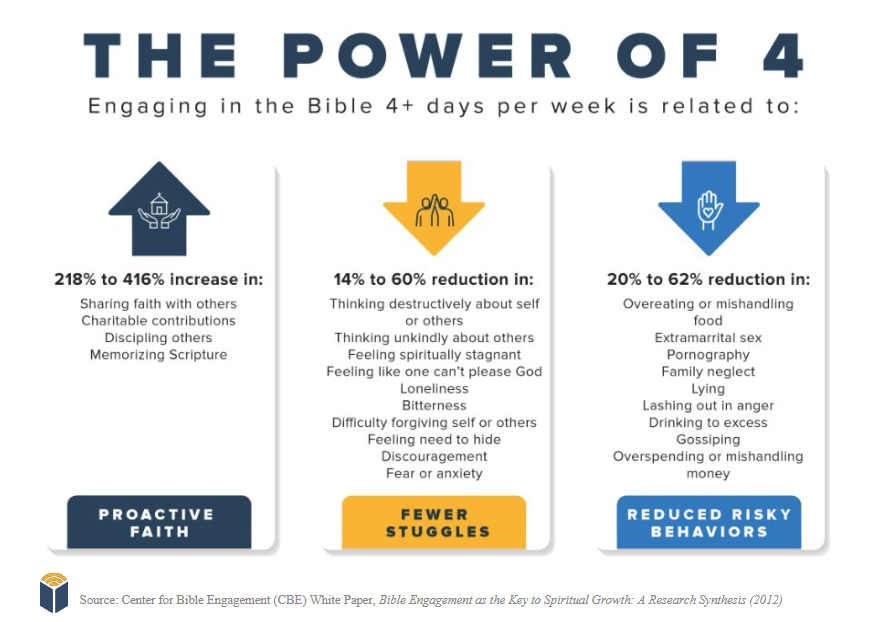
    The study, “The Power of 4”, reveals that devoted reading of the Bible affects the reader: A study by Center for Bible Engagement.

    • Focus: How engaging with the Bible impacts spiritual transformation, using research to create resources for daily engagement.
    • Key Finding: “The Power of 4” effect, which shows that engaging with Scripture at least four times a week is a strong predictor of spiritual growth compared to less frequent engagement.
      • More likely to disciple (+231%)
      • Sharing their faith with others (+228%)
      • More likely to cheerfully give to their church (+416%)
      • Cheerfully giving to causes other than their church (+218%)
    • Specifics of “The Power of 4”: Compared to those who don’t engage with the Bible most days, people who engage in Bible reading 4+ days a week are significantly more likely to have:
      • Higher rates of memorizing Scripture (+407%)
      • Lower rates of viewing pornography (-59%)
      • Lower rates of loneliness (-30%)
      • Higher rates of sharing their faith (+228%)


    The Center for Bible Engagement found that reading the Bible at least four times per week (“The Power of 4”) is the strongest predictor of spiritual growth. People who engage Scripture this consistently show dramatic increases in sharing their faith, discipling others, and living out Christian practices, along with sharp decreases in harmful behaviors and emotional struggles. Overall, consistent interaction with God’s Word is the key factor most strongly linked to real spiritual transformation. Want to see the data for yourself? Follow the link here and read the full study—you’ll be encouraged by what they discovered.